As 2023 draws to a close, I find myself looking back on the lessons another year has offered. Looking back often comes more naturally to me than looking forwards – in reaching back, I find meaning that enables me to find myself anew. In previous years, I have chosen words like growth and curiosity to propel me into January. 2023 has taught me the universe has its own plans, and such words might be better felt on reflection, at the waning of the year. If I had to choose words to describe 2023, terms like unsettled, challenging and loss most closely fit with my experience. Yet challenging times can also offer their own lessons.
As December fades, it is learning, rather than words and plans, carrying me into another year.
*
2023 began with snow and the news that funding would not be renewed for my third-
sector job beyond springtime. Through no one’s fault, this situation heralded the start of a difficult spell, and in the months to come, I would find myself lacking confidence and feeling strained. At the end of this period I found a hag stone (a stone with a naturally-occurring hole through it). In folklore, these objects are imbued with magical properties, and can be associated with ‘second sight’ and the power to heal. I took this stone as a sign, a theme which would run through 2023, when various other signs would appear at transitional life-moments. After finding my hag-stone, I enrolled on a course on Health and Wellbeing Through Art-Making, and discovered I had been selected for mentoring on my work-in-progress by author Malachy Tallack. These things remain highlights of a year which offered more challenges than opportunities. Developing my creative practice and benefitting from the mentoring support provided by Malachy has allowed me to grow, even when I’ve questioned my ability to write. Rejection, something I am normally reasonably adept at handling, stung a little more in its readiness and frequency this year. If things have their seasons, my resilience was winter-bare.
My dwindling self-confidence extended to paid work and the search for new employment. Having studied to postgraduate level and spent ten years in training and development prior to having children, I was now applying for jobs with insecure contracts, paying little more than minimum wage. Job interviews came and went, and my lack of suitability fostered a dollop of self-pity and a sense of worthlessness. Compounded by the impact of perimenopause, I felt washed up in midlife, and humbled, if not humiliated, by certain experiences in my life. During this time, I became acutely aware of the challenges faced by women seeking a return to the workplace after caring for children (in my case, following an extended career break in which I had engaged periods of self-employment, volunteering, and writing, and despite many expressions to the contrary, always ‘worked’).
Happily, towards the end of the year, I secured a new part-time role which fits well with my qualities and skills, while still allowing me to pursue my writing. I had other successes, including leading a campaign to reinstate a local school bus service following its withdrawal earlier in the year. It is easy, now, to forget the months of emails, petitions, media and meetings which led to that reinstatement. When I find my resolve crumbling, I cling to these small achievements and remind myself that, aged forty-seven, I still have much to give.
Inevitably, a year of turmoil will reflect in personal growth and relationships. Early in the year, I did some self-awareness work, including taking the Enneagram type indicator test (according to which I am a ‘Peacemaker’) and the Myers-Briggs-inspired 16 Personalities (in which I am an INFJ-T Advocate) – indicators of altruism and empathy, which, less helpfully, come with a dose of self-suppression and a tendency to put the needs of others before ourselves. Both types resonated for me – as an empath and lifelong people-pleaser, I have often found myself smoothing things along for other people while setting aside my own needs and feelings. For most of my life, I have avoided conflict, thrown apologies around like confetti, and suppressed my emotions around treatment I have found unfair. More often than not, this has led to resentment, often accrued in hindsight at the expense of my own health and wellbeing. In 2023, I grew in the realisation that acceptance from others should not be conditional on me putting my views and feelings aside or staying silent. It is strangely freeing, in midlife, to know that I can be a kind and empathetic person who also has boundaries, and a healthy respect for her own needs.
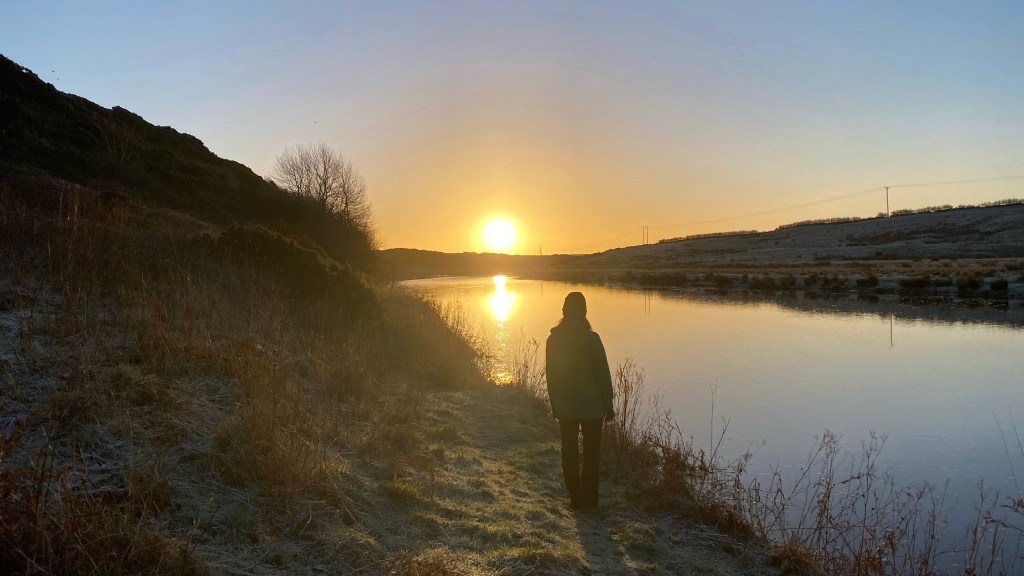
If challenging years highlight where things need to be realigned, they also deepen the bonds and relationships we hold dearest. Concern for the health of a loved one and the rallying of family and friends reminded me of the abundance in my closest relationships this year. A summer visit to Orkney with my parents, a friend’s fiftieth birthday retreat at Dunnet Head, a family break to Aviemore and several evenings with my ‘gorgeous lady’ friends (who know who they are) provided respite. Weekly sea-dips with another close friend, and correspondence from one who no longer lives nearby, cemented bonds that have held strong. The love of my husband and my two teenage sons, who are maturing into the most wonderful young men, has been my constant.
I would need that constancy more than ever when my world fractured in October following the loss of our beloved family dog.
I have written at length about Brody’s dramatic decline following the revelation that he was suffering with cancer. Brody’s death plunged me into grief unlike anything I have experienced, and in losing him, I also lost a piece of me. In the eight weeks between his death and Christmas Eve (when Brody would have been exactly eleven-and-a-half), I was consumed with pain, a literal and physical aching. Outside mothering and working, I made my life very small, every available space given over to mourning and honouring the canine keeper of my heart. I lit candles and wrote about Brody on social media. On walks, I spoke to dog owners and told them about the loss of my darling pet. I cried openly, at the vet’s, at the front gate of an acquaintance’s home, and during a day in Inverness, in the shopping precinct. I sobbed in front of near-strangers, while friends who had never seen me crying watched tears slip down my cheeks. I felt profoundly connected to other people and their personal losses. I noticed rainbows, and believed they were signs from my precious boy. In December, when my husband spent most of the month away from home for work, I spent my time alone while the kids were at school. Though I had many kind offers of company, I wanted to sit with my loss, or walk the coast for miles processing and noticing my grief. I thought about how safe I had felt, for almost eleven-and-a-half years, in the confidence of going home to my affectionate Vizsla. Everywhere I went was filled with the absence of him, and despite the love it still contained, our house felt much less like a home.
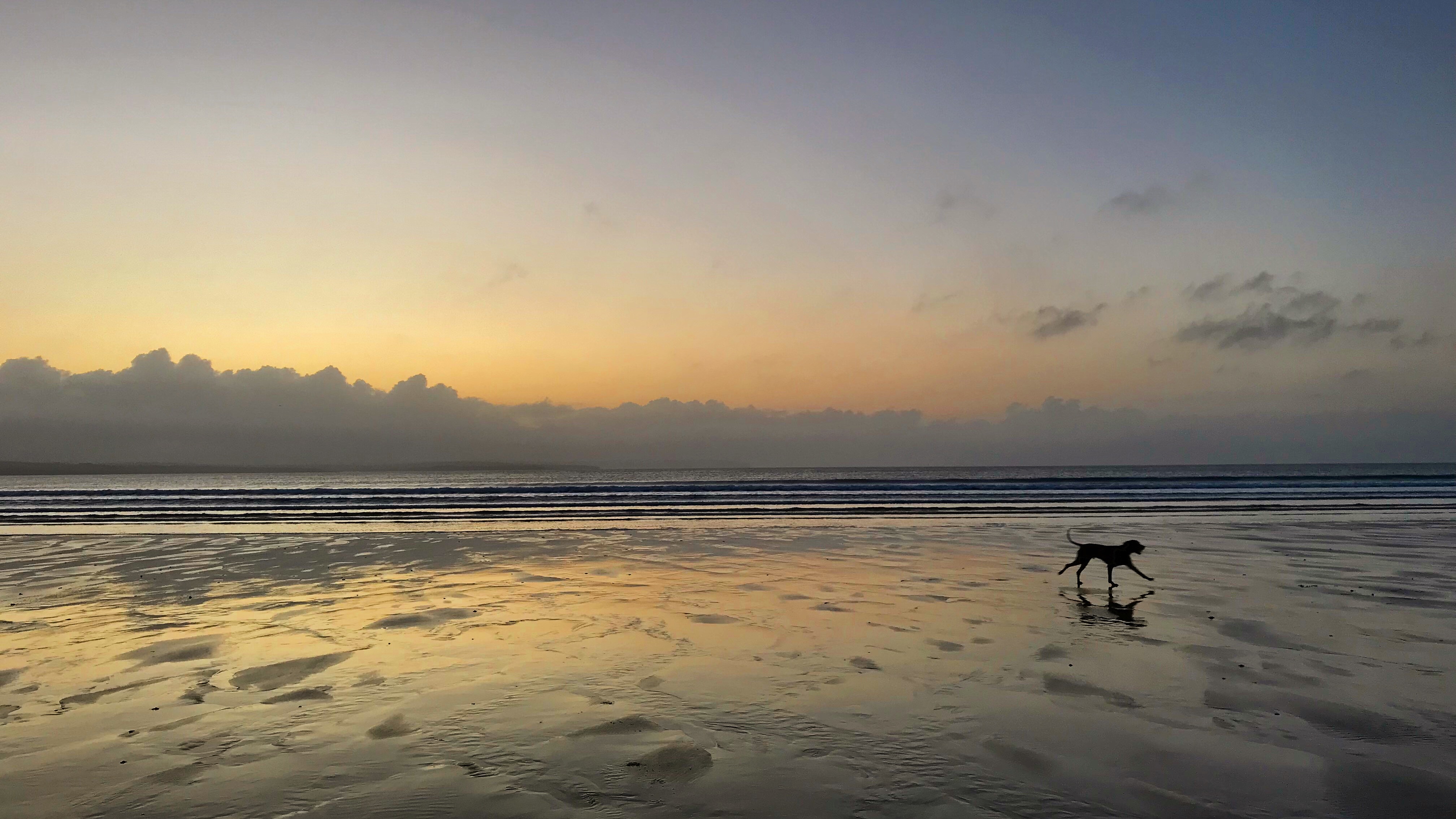
As Christmas approached, I hung a Vizsla-shaped decoration with Brody’s name on it on the Christmas tree. I folded his winter coat and Christmas treat bag, and laid them carefully on a tray beside the couch. On Christmas Eve, like every other Sunday since his death, Brody’s candle flickered in the kitchen. That day, I had seen a huge rainbow, in his usual spot, hanging in the bay. Aloud, I wished Brody a happy half-a-birthday. The previous day, I had reached the milestone of my 100th Parkrun, which I’d dedicated to Brody, who had very nearly reached his 100th Parkrun, too. Having spent two months observing ritual and memorialisation, I knew there was no moving on, just moving forwards. From now on, I would light a candle whenever I needed to feel my Vizsla’s light.
During those weeks before Christmas, it occurred to me that everything about my grief for Brody was the opposite of the self-suppression highlighted in my personal development work. Despite experiencing the world deeply, I had always tended to keep my emotions tightly wrapped inside. Having witnessed the harm this had caused, it was liberating to express grief in a way that was both entirely involuntary, and (regardless of how anyone else might regard pet grief), completely healthy. The loss of my companion had broken my emotions wide open. My dog, who in life had taught me so many things, was now offering me another lesson.
In death, Brody was teaching me to let go.
At Christmas, I was surrounded by family. A fortnight with my husband and our two sons was to be the perfect gift. In the smallest of steps, grief returns to join love, the seed it springs from.
And for the first time in months, I meant it when I smiled.
G. x
Sending you and your loved ones best wishes for 2024.


 Gail Anthea Brown
Leave a reply to Linda Cancel reply