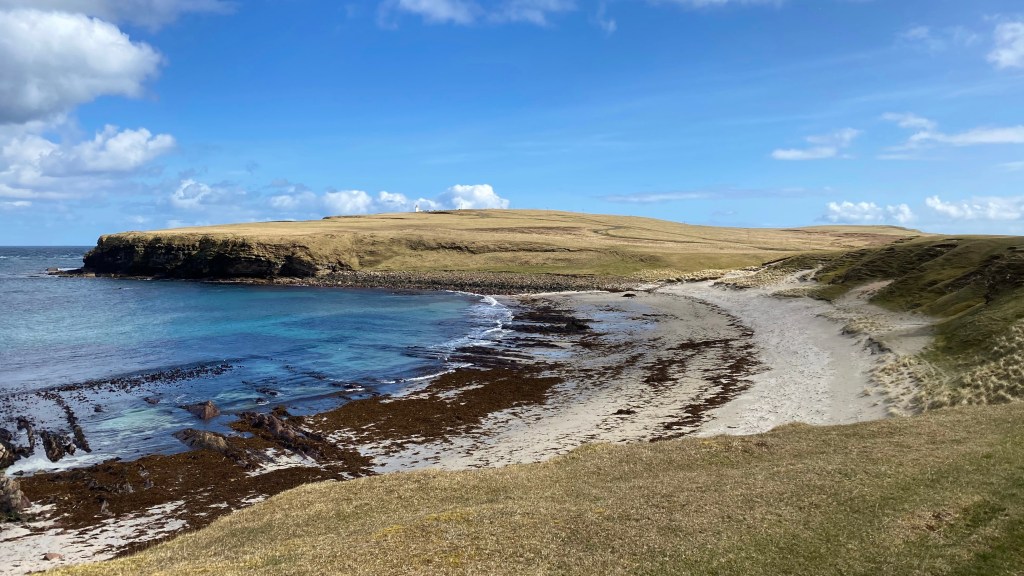
At the tip of the UK mainland, the land falls away to the Pentland Firth and cliffs graze the vast sky like the shoulders of giants. From where I live in the most northerly town before the islands, I watch a cobalt-glittered sea stretch under the shelf of Dunnet Head. The Head marks the most northerly spot on the mainland, a feature often misattributed to John O’ Groats, a nearby neighbour of some eleven miles or so. This coast sings with a sense of history, of north-ness, of millennia. And yet, the place also whispers with a sense of impermanence.
Of fragility.
Of the vulnerability of passing through.
I have lived here most of my life, yet the place speaks to me with a sense of its sureness, of enduring beyond the lives that pass through it. I need the land, but the land can do without me. I am rooted, but the place would carry on without my roots. Sandstone cliffs rise up like warriors, reminding me of my smallness, of the transience of my human form in this place. Unparalleled light rests on the bows of morning, unending skies shift back to darkness. Winter’s geese arrive and leave on spring’s coat-tails. The aurora blossoms and then fades.
The past wanders this place, reminding us of who we are, where we come from. Ruins dot the landscape like echoes. Time turns both the castle and the cottage into dust. History stands beside us, in a step over a stile, or on a bend in the windswept coastline. We can walk into it, over it, through it. It is fragile, and sometimes so quiet we barely know it’s there.
I walk a path to the beach, following the memories of my childhood. A space in a drystone wall marks the spot where my mother once paused on her walk to school. She made porridge there, in imaginary bowls of oatmeal. The wall is draped with moss now, and the gate next to it is locked.
The dunes reach out to the distance and the sky piles with clouds and contrast. The land stills, but it is never quite the same. It transforms, taking the shape of the new, holding its palm flat for us to walk on. Windmills survey peat bogs and tourists park up in ever-larger vehicles. Clouds drift and the tide turns, breathing it all into the rhythm of the sea.
Along the coast, I visit a beach that sweeps under cliffs in curves of sand and shingle. I pick over seaweed-strewn rocks gracelessly, feeling glad that I’m alone. In Gaelic, the name I had before I was married means ‘island’. I think of that as I look over towards Stroma, an uninhabited island belonging to my county, a place people once belonged to, in the days before they left.
But today I am here for something else, a thing that rests under the sea until the tide sees fit to show it. For here is a treasure under inky-blue skies and seaweed, a gift of verse someone etched onto the reef. I have been here before, searching out the words rendered on these rocks by a person of unknown identity. I imagine some sensitive soul who chisels poetry onto stone in sweeping patterns, thrilled by the knowledge that the letters are visible only at low tide, and when the Pentland Firth allows. As I flounder on sea-soaked coils, the verse shows itself to me, appearing under my reaching, grasping fingers. Its path stretches over the reef in a line of poetry-painted pink, traversing a way back to the sea. I’m told the words belong to Chilean poet Pablo Neruda, the inscriptions part of his suite of poems Stones of the Sky. The words speak of borderless night, unending brilliance.
Right now on the beach, the words belong to me.

I listen for the poem’s voice as I look out at the horizon and the headland. But the verse sings silently, to be gathered by the ocean on the tongues of lapping waves. Like the land on which I rest, the words are changing. In the decade since they were discovered, they have begun to pull away into the sweep of the leaving tide. Eventually, they will be lost completely to the Pentland Firth, like the boats that have been swallowed by these unforgiving waters. This loss will happen slowly, an erosion so gradual we will barely notice it at all. One day, we will seek out the words on the rocks and they will be gone, a memory of fragility.
They will belong to the sea, then, and the waves that reach to the shore like thunder, or soft rain on a summer’s day.
I lift myself up from the rocks, hearing the drone of traffic in the distance. Visitors swarm at John O’ Groats, while nearby, sheep huddle in the wind. Few folk come here for the poetry now, but the land breathes itself anew, turns, changes.
This place is my home, my shelter.
And I am its guest, walking the beach of its open palm.
Stones of the Sky first appeared in Fieldfare issue 2

 Gail Anthea Brown